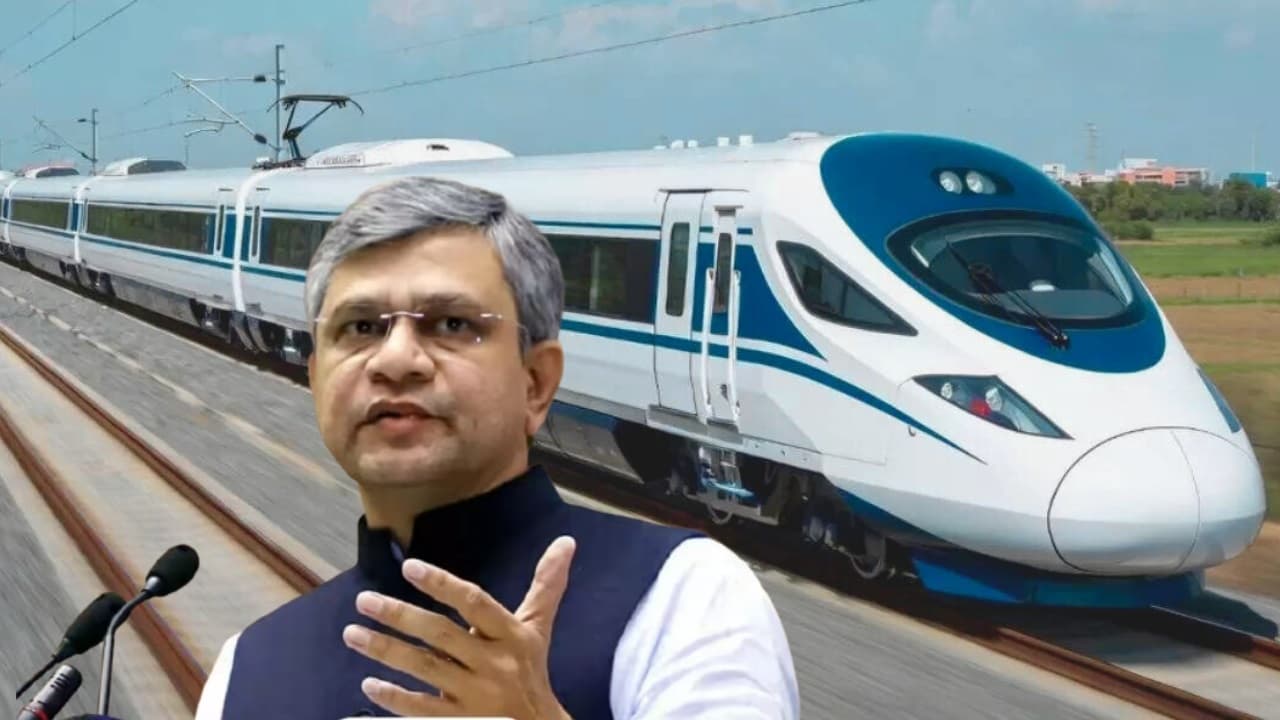
Union Railway Minister Ashwini Vaishnaw has announced that India’s next-generation indigenous bullet train will be designed to operate at speeds of up to 350 kmph, marking a major leap in the country’s high-speed rail ambitions and domestic railway technology capabilities.
According to the Railway Minister, design work for the new high-speed train platform will begin within the next six months. The upcoming train is expected to become India’s fastest indigenously developed rail system and represents the next phase of the country’s bullet train and advanced rail mobility programme.
The announcement comes as Indian Railways and domestic manufacturers are already working on the B28 high-speed trainset project, which is currently being developed jointly by BEML Limited and the Integral Coach Factory. The B28 trainset has been designed for speeds of up to 280 kmph and is expected to serve as India’s first indigenously developed high-speed rail prototype.
Officials stated that the future 350 kmph platform will build upon the technological experience gained through the B28 programme and could evolve into a new “B35” category high-speed train specifically designed for ultra-high-speed operations on future dedicated corridors.
The B28 prototype is expected to be ready by early next year and may initially operate on sections of the Mumbai–Ahmedabad High-Speed Rail corridor beginning around 2027 for trials and operational integration.
According to railway officials, the new indigenous high-speed trains are being engineered specifically for Indian climatic and operational conditions, including high temperatures, dust exposure, humidity, and heavy rainfall environments. The trainsets are expected to feature advanced aerodynamics, distributed traction systems, enhanced safety architecture, intelligent monitoring systems, and high-performance braking technologies.
The announcement also aligns with India’s broader strategy to reduce dependence on imported railway technology under the government’s Atmanirbhar Bharat initiative. Authorities are increasingly focusing on localisation of high-speed rolling stock, signalling systems, traction technologies, and rail manufacturing capabilities.
Alongside the bullet train programme, the Railway Minister also highlighted efforts to increase domestic freight movement through railways to reduce fuel consumption and dependence on road-based logistics. Indian Railways is currently working on reforms aimed at boosting domestic container traffic, freight efficiency, and multimodal logistics integration amid rising global crude oil prices and geopolitical uncertainties.
India’s high-speed rail ecosystem has been expanding rapidly in recent years. In addition to the Mumbai–Ahmedabad Bullet Train project, the government is also planning multiple future high-speed and semi high-speed corridors including Delhi–Varanasi, Mumbai–Nagpur, Chennai–Mysuru, and Ahmedabad–Dholera routes. Several proposed corridors are being designed for operational speeds ranging between 320 kmph and 350 kmph.
Railway experts believe the development of a 350 kmph indigenous train platform could become a landmark achievement for India’s rail manufacturing sector by positioning the country among a limited group of nations capable of designing and producing advanced high-speed rail systems domestically. The project is also expected to support the growth of India’s railway engineering, component manufacturing, signalling, and precision industrial ecosystem