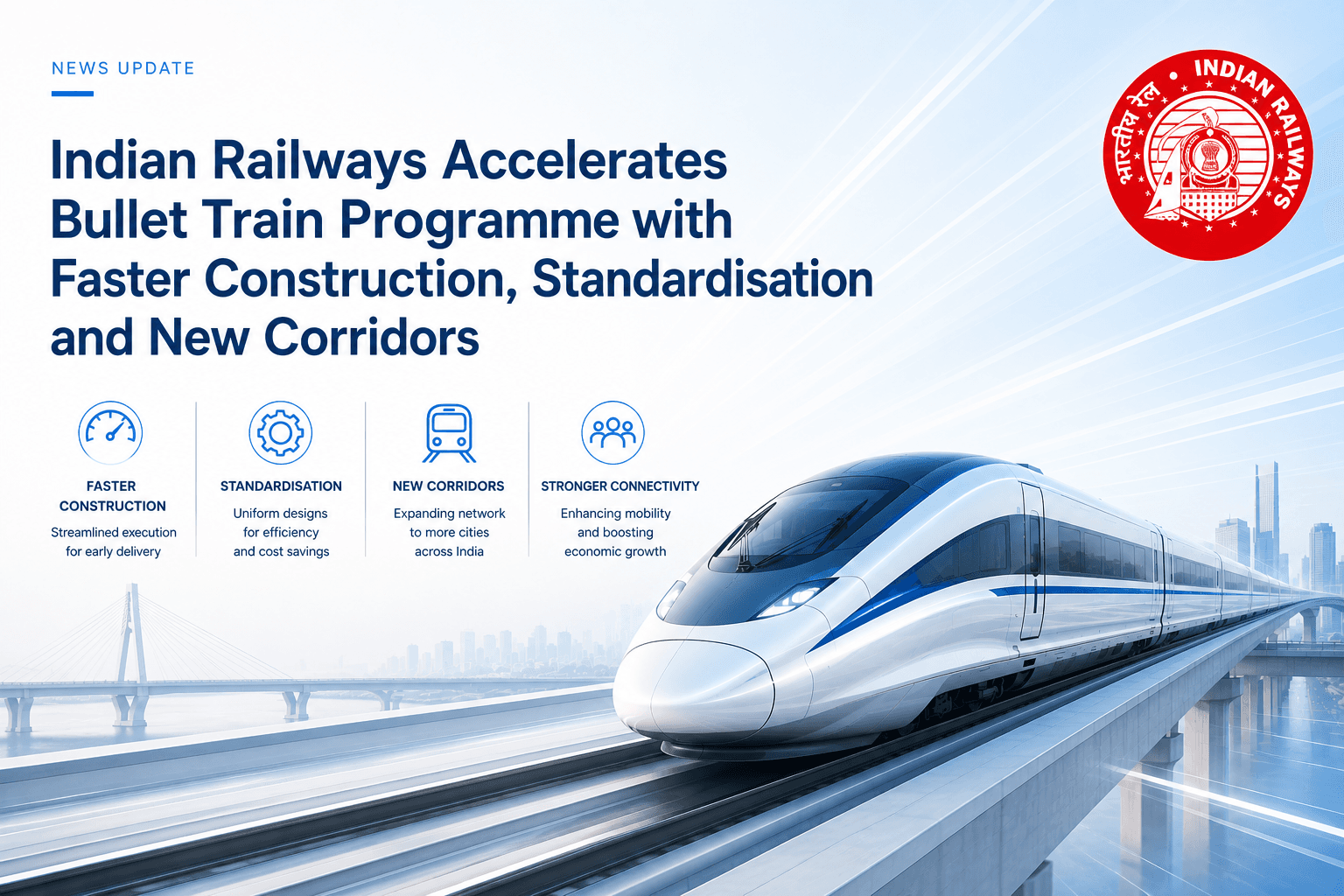
India is significantly accelerating its high-speed rail programme, with construction speeds reaching up to 15 km of track per month, alongside a broader strategy focused on standardised technology and expansion into new corridors.
Union Railway Minister Ashwini Vaishnaw stated that the pace of bullet train construction has improved sharply due to advancements in domestic engineering capabilities and the adoption of global best practices. The current speed marks a major jump compared to earlier global benchmarks, where high-speed track construction typically progressed at much slower rates.
The progress is most visible in the Mumbai-Ahmedabad High-Speed Rail project, India’s first bullet train corridor, spanning 508 km. The project is being executed in phases, with an initial 97 km stretch between Surat and Vapi expected to be operational first.
Designed for speeds of up to 320 km/h, the corridor represents a major leap in India’s rail infrastructure, incorporating advanced systems such as dedicated tracks, modern signalling, and high-speed rolling stock.
A key policy shift underpinning the programme is the standardisation of bullet train technology, including track systems, components, and design specifications. This approach is aimed at reducing costs, improving execution timelines, and enabling large-scale domestic manufacturing of critical components.
The move is also expected to create a replicable framework for future high-speed rail projects, allowing faster rollout across multiple corridors.
In addition to ongoing construction, the government has outlined plans to develop seven new high-speed rail corridors, covering nearly 4,000 km and involving investments of around ₹16 lakh crore.
The Mumbai–Ahmedabad project, which began construction in 2021, has faced delays primarily due to land acquisition challenges, particularly in Maharashtra. These delays have also led to a rise in project cost estimates.
Despite this, construction momentum has improved, supported by better coordination, faster approvals, and the development of specialised infrastructure such as geotechnical laboratories for soil testing.
With faster execution, a standardised technology framework, and ambitious expansion plans, India’s bullet train programme is entering a more accelerated phase.
Once operational, the network is expected to transform intercity mobility by drastically reducing travel time, enhancing logistics efficiency, and supporting economic growth across emerging corridors.