As the construction industry moves toward lower emissions and faces increasing limitations in grid access, the electrification of heavy lifting equipment is gaining momentum. Addressing these evolving requirements, Manitowoc has rolled out a plug-in hybrid all-terrain crane that combines operational efficiency with reduced environmental impact.
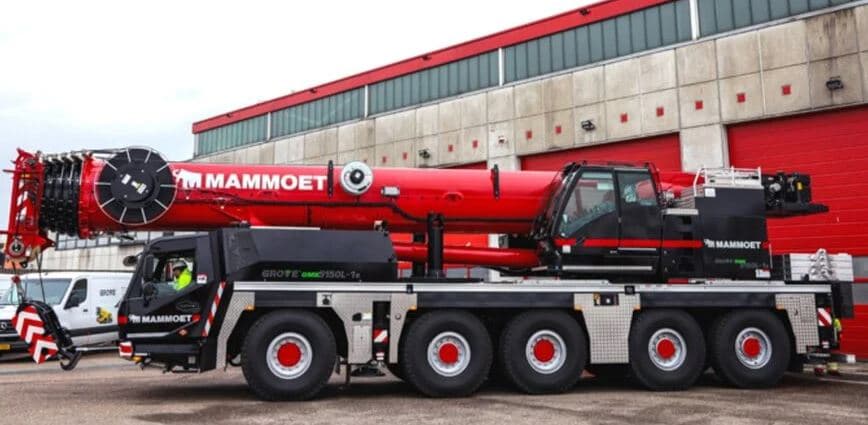
The company has delivered its first Grove GMK5150L-1e hybrid crane to Mammoet, marking an important step in the transition toward cleaner lifting solutions for complex project environments.
The Grove GMK5150L-1e, positioned in the 150-tonne category, is designed to offer performance comparable to conventional diesel cranes while introducing electric lifting capabilities. It is equipped with a 160 kWh battery pack that powers the superstructure, enabling emission-free lifting operations at the jobsite.
Featuring a 60 m main boom, the crane is part of Manitowoc’s expanding electrified lineup. This range also includes the GMK5150XL-1e variant, which offers an extended boom configuration and was showcased at bauma 2025. Both models are built to handle diverse terrain conditions commonly encountered in infrastructure and industrial projects.
One of the key highlights of the hybrid crane is its ability to recharge while in transit between job locations. This capability helps reduce dependence on fixed charging infrastructure, which is still limited across many construction sites.
In addition, the crane supports multiple charging methods, including DC fast charging, 32 A / 400 V AC supply, and an onboard 163 kW generator. This multi-source charging flexibility ensures consistent battery availability and minimizes operational downtime across different working conditions.
With stricter emission norms and growing focus on sustainability, especially in urban construction, equipment with lower environmental impact is becoming essential. Hybrid crane technology enables contractors to carry out lifting operations electrically while retaining diesel-powered mobility for transportation.
This dual-mode functionality allows operators to meet environmental requirements without compromising on performance or site accessibility, particularly in regions where charging infrastructure is still developing.
The development of the crane was guided by feedback from end users, with a strong emphasis on real-world operating conditions such as duty cycles, energy usage patterns, and site constraints. Battery capacity and system configuration were optimized to ensure reliable and efficient performance during actual lifting operations.
This approach reflects a broader industry trend where equipment design is increasingly influenced by practical application needs rather than theoretical benchmarks.
Operating the crane in electric mode significantly reduces noise levels, creating a more comfortable working environment for operators and surrounding personnel. This is especially beneficial in urban or noise-sensitive project sites.
At the same time, the hybrid system is seamlessly integrated with traditional all-terrain crane functions, allowing operators to transition between travel and lifting modes without any major changes to standard workflows.
The related GMK5150XL-1e model has also gained industry recognition for its innovation, including acknowledgment in European industry platforms and selection as a finalist in the ESTA Awards of Excellence 2026.