Parker Hannifin has expanded its electric vehicle motor platform capabilities, reinforcing its strategy to deliver fully integrated electrification solutions for mobile and off-road applications.
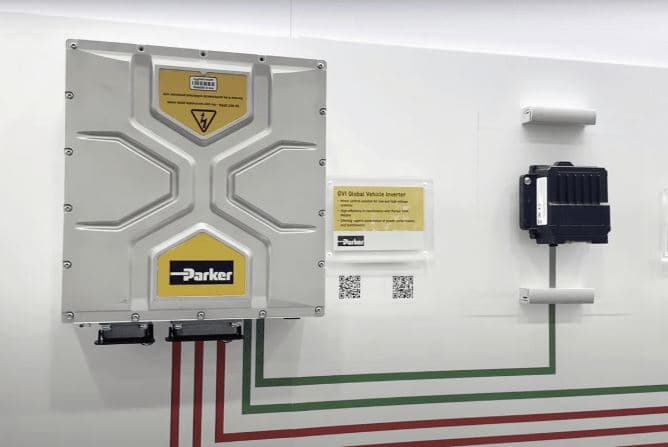
The development focuses on strengthening the integration of motors within broader electric powertrain architectures, enabling manufacturers to move beyond standalone components toward complete, system-level solutions. This approach allows seamless compatibility between motors, inverters, cooling systems, and control technologies, an increasingly critical requirement as electrification accelerates across construction, industrial, and commercial vehicle segments.
At the core of this expansion is Parker’s evolving motor portfolio, including platforms such as the NX8M mobile motor series and GVM (Global Vehicle Motor) range, which are designed to support a wide spectrum of electric and hybrid applications. These motors are engineered for high power density, compact packaging, and flexible integration, making them suitable for space-constrained and performance-intensive environments.
The company’s integrated platform strategy enables higher system efficiency by aligning motor performance with battery systems and electronic controls. This results in optimised energy usage, improved thermal management, and enhanced overall vehicle performance, particularly in demanding applications such as construction machinery, mining equipment, and material handling systems.
Another key aspect of the integration approach is modularity. Parker’s motor platforms are designed to adapt to different voltage architectures, including high-voltage systems up to 800 VDC, allowing OEMs to scale solutions across multiple vehicle types and duty cycles.
The expanded platform also supports a wide range of applications from construction equipment and refuse vehicles to cranes, utility vehicles, and electro-hydraulic systems highlighting its versatility across both on-road and off-road electrification segments.
In addition, Parker continues to strengthen its electrification ecosystem through strategic moves such as technology integration and acquisitions, aimed at combining motor control, power electronics, and software capabilities into a unified offering.
This shift toward integrated motor platforms reflects a broader industry transition, where OEMs are increasingly seeking end-to-end electrification partners rather than individual component suppliers. By aligning hardware, software, and system engineering, Parker is positioning itself to support the next phase of high-efficiency, scalable electric mobility solutions.
The expansion underscores how electric vehicle development is evolving from component innovation to platform-level integration, where performance, efficiency, and compatibility are engineered together from the ground up.