The Rajasthan Solar Association (RSA) has called on the Ministry of New and Renewable Energy (MNRE) to adopt a phased and pragmatic implementation strategy for the upcoming ALCM/ALMM List-II framework for solar cells, warning that a sudden transition could create supply-chain disruptions, increase project costs, and impact renewable energy deployment across the country.
The framework, which mandates the use of domestically manufactured solar cells, is scheduled to come into effect from June 1, 2026. While reiterating its support for the Government of India’s vision of strengthening domestic manufacturing under the Atmanirbhar Bharat initiative, RSA stated that the industry’s current manufacturing ecosystem may not yet be fully prepared for an immediate shift.
According to the association, India currently has around 33.78 GW of approved domestic solar cell manufacturing capacity, compared to a rapidly expanding 220 GW-plus module manufacturing base. This imbalance could create a shortage of compliant domestic cells, potentially affecting project execution across the solar value chain.
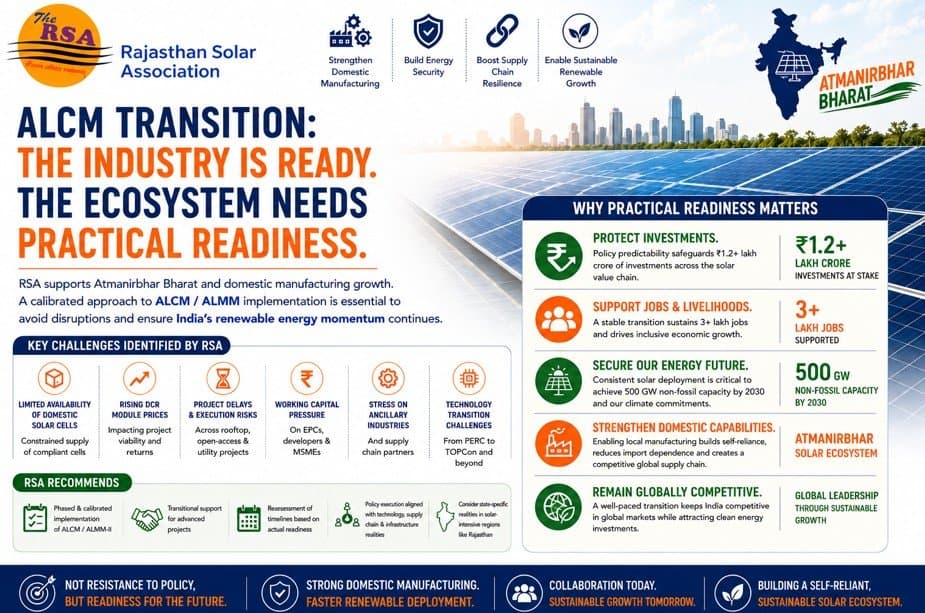
RSA highlighted several potential challenges that could emerge during the transition period, including limited availability of domestic solar cells, procurement bottlenecks, higher Domestic Content Requirement (DCR) module prices, project delays across rooftop, commercial & industrial (C&I), and open-access segments, as well as increased working capital pressure on EPC companies and MSMEs. The association also noted that ancillary industries such as solar glass, EVA sheets, junction boxes, ribbons, and other component manufacturers could face temporary demand disruptions.
Industry estimates cited by RSA indicate that DCR module prices have already experienced upward pressure due to limited cell availability, with further increases anticipated after the implementation of the new framework. Additionally, the association pointed to technology-related challenges, noting that a significant portion of India’s current manufacturing base remains focused on Mono PERC technology, while project developers and investors are increasingly favouring TOPCon-based solutions.
RSA also emphasized the time required to establish new manufacturing capacity, stating that solar cell facilities typically require approximately six months for installation and another six months for operational stabilisation and efficiency optimisation before achieving commercial-scale production.
To ensure a smoother transition, the association has recommended a phased implementation roadmap, transitional support for projects already under execution, periodic reassessment of timelines based on manufacturing readiness, closer alignment of policy with supply-chain realities, and consideration of infrastructure challenges in solar-intensive states such as Rajasthan.
Commenting on the issue, Nitin Agrawal, CEO of Rajasthan Solar Association, said that while the industry strongly supports India’s long-term objective of building a self-reliant renewable energy manufacturing ecosystem, successful implementation requires realistic timelines, policy stability, and adequate ecosystem preparedness. He emphasized that a balanced transition would help strengthen domestic manufacturing without compromising renewable energy growth, investor confidence, or project execution momentum.
As part of its efforts to facilitate industry engagement, RSA will host an “Industry Dialogue on ALCM Implementation & Solar Market Readiness” on May 25, 2026, bringing together manufacturers, developers, EPC companies, policymakers, and renewable energy experts to discuss market preparedness, supply-chain challenges, pricing implications, and potential measures to support a smooth implementation process.
The association maintained that its objective is not to oppose policy reforms but to ensure that the transition toward domestic manufacturing is implemented in a manner that preserves industry stability and sustains India’s renewable energy growth trajectory.