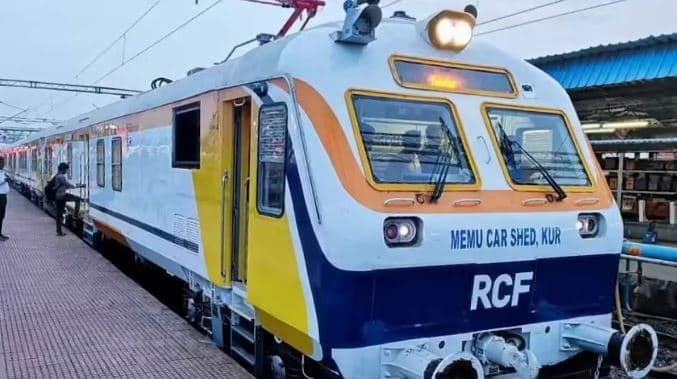
Indian Railways has approved a new Mainline Electric Multiple Unit (MEMU) rail service between Delhi and Faridabad, providing a major boost to daily commuter connectivity across the National Capital Region (NCR). The approval was granted by Union Railway Minister Ashwini Vaishnaw following a request from Delhi Chief Minister Rekha Gupta.
The newly approved service is expected to provide relief to thousands of passengers travelling daily between Delhi, Faridabad, and adjoining NCR areas for work, education, business, and other purposes. Officials stated that commuters have long demanded additional suburban rail services due to overcrowding and gaps in existing transport options.
According to Railway Board communication, train numbers 64038/64037 Delhi–Faridabad MEMU have been approved for daily operation and are expected to commence services after completion of operational formalities.
As per the proposed schedule, the 64038 Delhi–Faridabad MEMU will depart Delhi at 10:30 am and reach Faridabad at 11:45 am. On the return journey, train number 64037 will leave Faridabad at 2:00 pm and arrive in Delhi at 3:45 pm.
The train will operate through important stations including Delhi, Sadar Bazar, New Delhi, Shivaji Bridge, Tilak Bridge, Hazrat Nizamuddin, Okhla, Tuglakabad, and Faridabad, strengthening suburban rail connectivity across one of NCR’s busiest commuter corridors.
MEMU trains are self-propelled electric multiple unit trains designed for short- and medium-distance travel on mainline railway routes. Unlike conventional trains, they do not require separate locomotives, as traction systems are distributed across coaches, enabling faster acceleration and operational efficiency. These trains generally operate at speeds of around 100–110 kmph.
Modern MEMU services are also equipped with upgraded passenger amenities such as LED lighting, CCTV surveillance, GPS-based passenger information systems, charging points, and bio-toilets to improve commuter experience.
Officials believe the new service will help reduce pressure on road traffic and existing metro systems while offering an affordable and faster mobility option for daily passengers travelling between Delhi and Faridabad. The corridor remains one of the most heavily used commuter routes in the NCR region.